

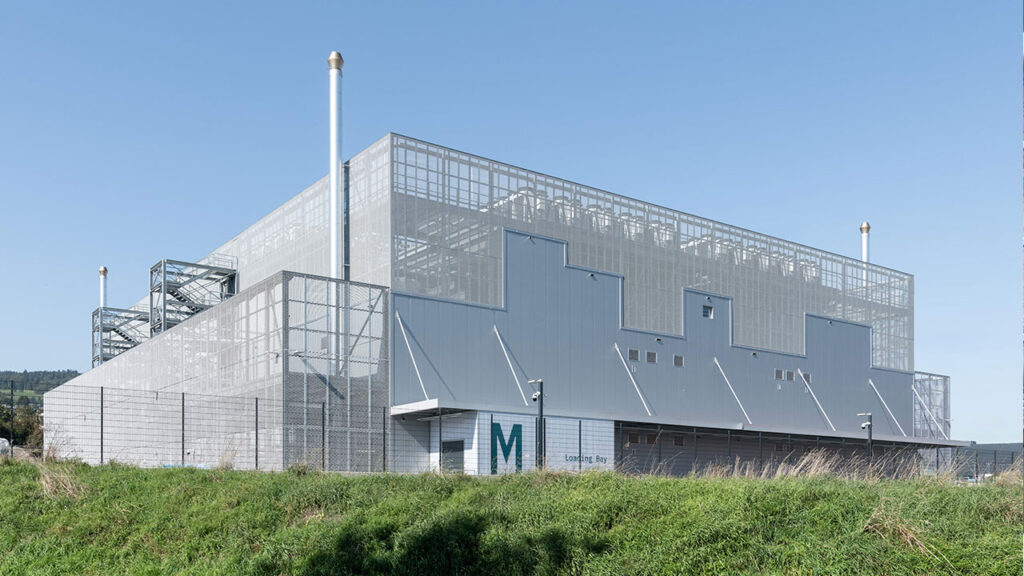
Wherever digital infrastructure is operated, valuable waste heat is generated. As CO₂-neutral district heating, it can supply entire communities. This is demonstrated by the current examples in Dielsdorf and Regensdorf. Transport is made possible by the pipe systems from BRUGG Pipes in Aargau.
Demand for modern, energy-efficient data centres is growing
Large data centres are currently being built in Switzerland because companies are increasingly turning to cloud solutions and digitalisation. As confirmed by the ‘Market Overview of Swiss Data Centres 2024’, Green is also one of the largest operators. In order to meet growing customer demand, Green is continuing to expand at the Metro Campus Zurich, among other locations. Three high-performance data centres for cloud providers (hyperscalers), companies and system integrators are being built on a 46,000 m2 site in Dielsdorf. The first data centre has been in operation since 2023, the second data centre will go live soon and another data centre has completed the civil engineering phase.
Great potential for waste heat
What many people don’t know is that customer systems (servers) in data centres generate considerable amounts of waste heat. Depending on the location, the waste heat can be fed into a new or existing heating network. The heating network, which is usually operated by an energy service provider, then supplies the surrounding buildings or – as in Dielsdorf, six municipalities – with heat for heating, hot water and commercial and industrial processes. Martin Rigaud, CEO of BRUGG Pipes, explains: “A report by Energie Schweiz (Swiss Federal Office of Energy SFOE) from 2023 estimates the theoretically extractable waste heat from data centres and server rooms in Switzerland at 2.02 to 2.62 TWh. In relation to this, waste incineration plants (KVA) in Switzerland produced a total of around 4.0 TWh of heat in 2017. This means that the potential for waste heat from data centres and server rooms is comparatively high, at 50–65 per cent of the heat produced in waste incineration plants. We must exploit this potential.”
Dielsdorf, Regensdorf and surrounding area: heating 11,500 households with three data centres
Green is building its data centres in Dielsdorf with waste heat extraction and is working closely with energy network operators such as Energie 360° and the local communities to ensure that the waste heat can be used for CO2-neutral heating. Thanks to the extraction, 11,500 households from six surrounding communities, industry and commerce will be supplied in future. The energy centre is being built right next to the data centres on Green’s Metro Campus. Another centre is planned in Regensdorf. Energie 360° plans to start supplying heat in 2026. Green already uses some of the waste heat in its own office building and supplies a nearby industrial plant. ‘Thanks to waste heat extraction, energy can be used twice: for digitalisation and for heating purposes – that’s why we are working with our partners to utilise waste heat from data centres,’ explains Roger Süess, CEO of Green. The waste heat will also be used at other Green Datacenter locations, and new district heating projects are planned.
Pipes with an external diameter of over 70 cm from Aargau

Energie 360° relies on pipes from the Aargau-based company BRUGG Pipes for the construction of its district heating networks. Martin Rigaud, CEO of BRUGG Pipes, says: ‘The data centres in Dielsdorf are a good example of how waste heat can be put to good use and CO2 emissions reduced.’ BRUGG Pipes delivered the first pipe rods for the district heating network in January 2024. Since then, BRUGG Pipes has delivered around 126 12-metre rods. This corresponds to a length of over 1.5 kilometres. The pipes are laid underground and are thermally insulated and monitored.
Martin Rigaud explains: “First, a trench is dug, into which the 12-metre-long pipe sections are laid and welded together. The trench is then filled in again and nothing can be seen from the outside. However, the pipes contain monitoring wires so that any leaks can be detected and located immediately. As you can see, even a pipe system can be smart and monitored these days.” In addition to the standard pipes, fittings (T-pieces) are also required for branches. These are manufactured according to customer requirements. Martin Rigaud adds: ‘The fittings are made by hand. Our welders in Kleindöttingen are true artists, and I am always positively surprised by how they produce such complex fittings.’ BRUGG Pipes is the largest Swiss manufacturer of district heating pipes and employs around 360 people in Switzerland.
Pipe solutions also within data centres

However, BRUGG Pipes does not only supply district heating pipes for waste heat from data centres. The company’s pipe systems are also used within the facilities themselves. In recent years, BRUGG Pipes has been involved in numerous data centre projects in Germany and internationally. With over 40 years of experience in the safe transport of liquid media, the company develops piping systems that play a central role in the operation of data centres. Among other things, they are used for cooling applications and for supplying fuel to emergency power generators.
Since the trouble-free operation of data centres depends on a reliable infrastructure, the pipes are designed for durability and safety. In addition, continuous leak monitoring ensures that potential faults are detected at an early stage. The systems are TÜV-tested and certified according to international standards such as UL 1369 and UL 971a. They therefore meet the high requirements for operational safety and energy efficiency that are demanded of modern data centres.